

It’s the question that comes up at every dinner table as soon as someone says they’re doing the Camino this year: on foot or by bike? And there’s usually a follow-up, sometimes with a raised eyebrow: “By bike it’s not the same.” “On an e-bike? That’s not a pilgrimage anymore.” “That’s for turigrinos.”
We’ve spent years watching people set off for Santiago in every way imaginable. In fact, the word bicigrino was born here: Tomás Sánchez, the driving force behind Bicigrino, coined it in 2006 for the travel blog of his first Camino by bike. It means a pilgrim who travels to Santiago by bicycle; more in what is a bicigrino. So let’s take a clear position on what really changes when you do the Camino de Santiago on foot or by bike, what an e-bike adds, what the Compostela rules say, and how much truth there is in the “turigrino” debate.
A few numbers to set the scene
The Camino keeps growing. In 2025 the Pilgrim’s Office in Santiago registered 530,987 pilgrims who received the Compostela, an all-time record. Most of them arrive on foot: in 2024, around 93% walked and just under 5% cycled. We cyclists are a minority, but one that grows every year, and 2027, a Holy Year, is expected to break records again.
That alone tells you something: bikes aren’t taking anyone’s place on the Camino. They’re opening it up to people who otherwise wouldn’t do it.
What the rules say: the Compostela on foot and by bike
The Pilgrim’s Office doesn’t divide pilgrims into first and second class. The requirements are simple:
- On foot or on horseback: cover at least 100 km of a recognised Camino route.
- By bicycle: cover at least 200 km.
- In both cases: get your credential stamped at least twice a day on that stretch, with the final stage ending in Santiago.
The distance doubles on a bike because a bike is faster, not because it counts for less. The effort asked of you is comparable.
And e-bikes? The rules published by the Pilgrim’s Office talk about bicycles and don’t mention electric ones. In Spain, a pedal-assist bike (one that only helps while you pedal and stops assisting at 25 km/h) is legally a bicycle. But the Pilgrim’s Office has stated that it does not issue the Compostela to pilgrims arriving on an e-bike, and Santiago’s tourism website says the same. We cover it in detail in our article on the Camino de Santiago by e-bike and the Compostela.
Walking the Camino: the original version
Walking has something no wheel can match. At 4 or 5 km an hour you go into every village, stop at every fountain and meet the same people for days on end. The “Camino family” that forms between Pamplona and Burgos is real, and many people come back for exactly that.
What to know before you choose it:
- Time. At an average of 20 to 25 km a day, the full Camino Francés from Roncesvalles (about 755 km) takes 30 to 35 days. Few people can take a whole month off.
- Your body. Blisters, knees and tendinitis are part of daily life. Nothing serious if you’re prepared, but worth knowing.
- The final stretch. People with only a week usually walk the last 100 km from Sarria, which gets very busy in high season.
It’s the ideal choice if you have weeks ahead of you, want the slowest, most reflective experience and love sharing a hostel and a conversation every night.
On a regular bike: the whole Camino in a normal holiday
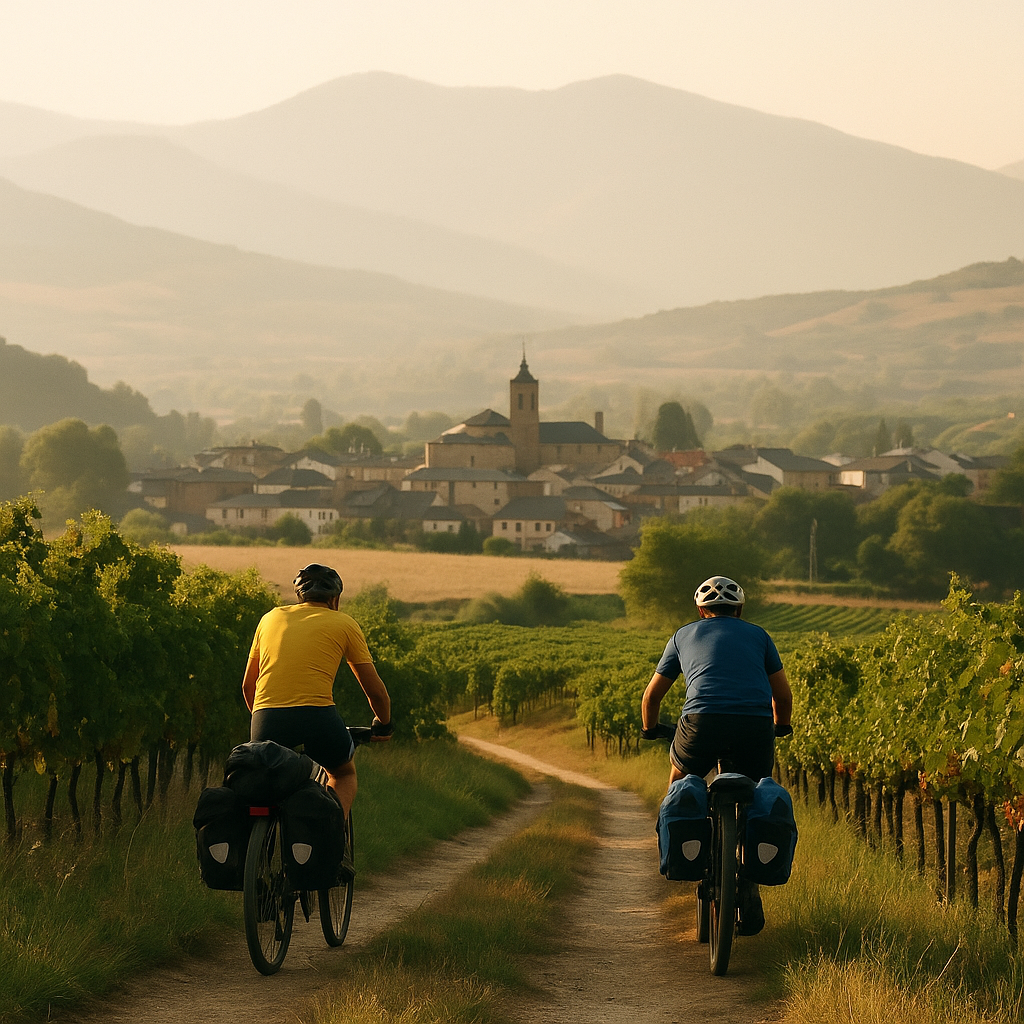
A bike changes the maths. An average bicigrino covers 50 to 80 km a day, depending on terrain and how often you stop. The same Camino Francés fits into 11 to 14 days, which is what most people have for a holiday. You go from doing a section to doing the whole thing, from the Pyrenees to the Obradoiro square.
And don’t think it’s a stroll. Climbing the Alto del Perdón, the Cruz de Ferro or O Cebreiro with loaded panniers is hard work. It’s a different kind of effort, but it’s effort.
Things to keep in mind:
- The right bike. Much of the Camino runs on dirt tracks and trails. A road bike won’t do; a mountain bike or a gravel bike will.
- Sharing the way with walkers. The Camino belongs to everyone, but walkers are slower and more vulnerable. Use your bell, slow down where it’s busy and say “Buen Camino” as you pass.
- Where to sleep. In many public hostels walkers get priority. On a bike it pays to book hotels, guesthouses or private hostels with secure bike storage.
- Basic mechanics. Knowing how to change an inner tube and carrying a puncture kit will save you a lot of trouble.
Who it’s for: people with reasonable fitness who want to see the whole Camino and don’t have a month free.
On an e-bike: the Camino for more people
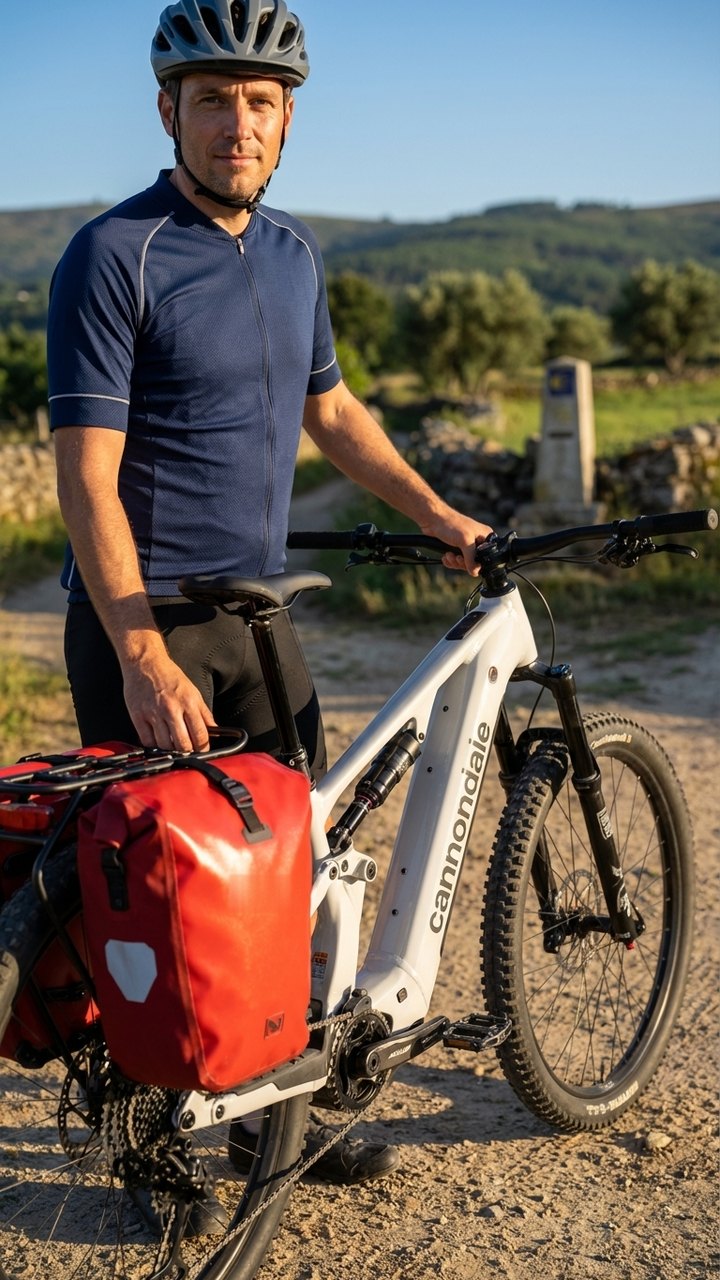
This is where the debate heats up, so let’s take it step by step. A pedal-assist e-bike doesn’t move on its own. If you don’t pedal, it doesn’t go. What it does is ease the climbs and spread the effort more evenly through the day.
Who chooses it? Here’s what we see every season:
- Couples or groups with very different fitness levels, who can now ride together.
- People over 60 who don’t want to give up on riding the full Camino.
- People with a knee or back problem that rules out walking 25 km a day.
- Anyone short on days who’d rather enjoy the scenery than spend the day staring at their front wheel.
It has its quirks: you need to charge the battery every night (most accommodation is fine with it if you mention it), plan your stages around the range, and it weighs more than a regular bike. With a 750 or 800 Wh battery and sensible use of the assist modes, normal Camino stages are easily done.
The debate: are e-bikes cheating? And what about turigrinos?
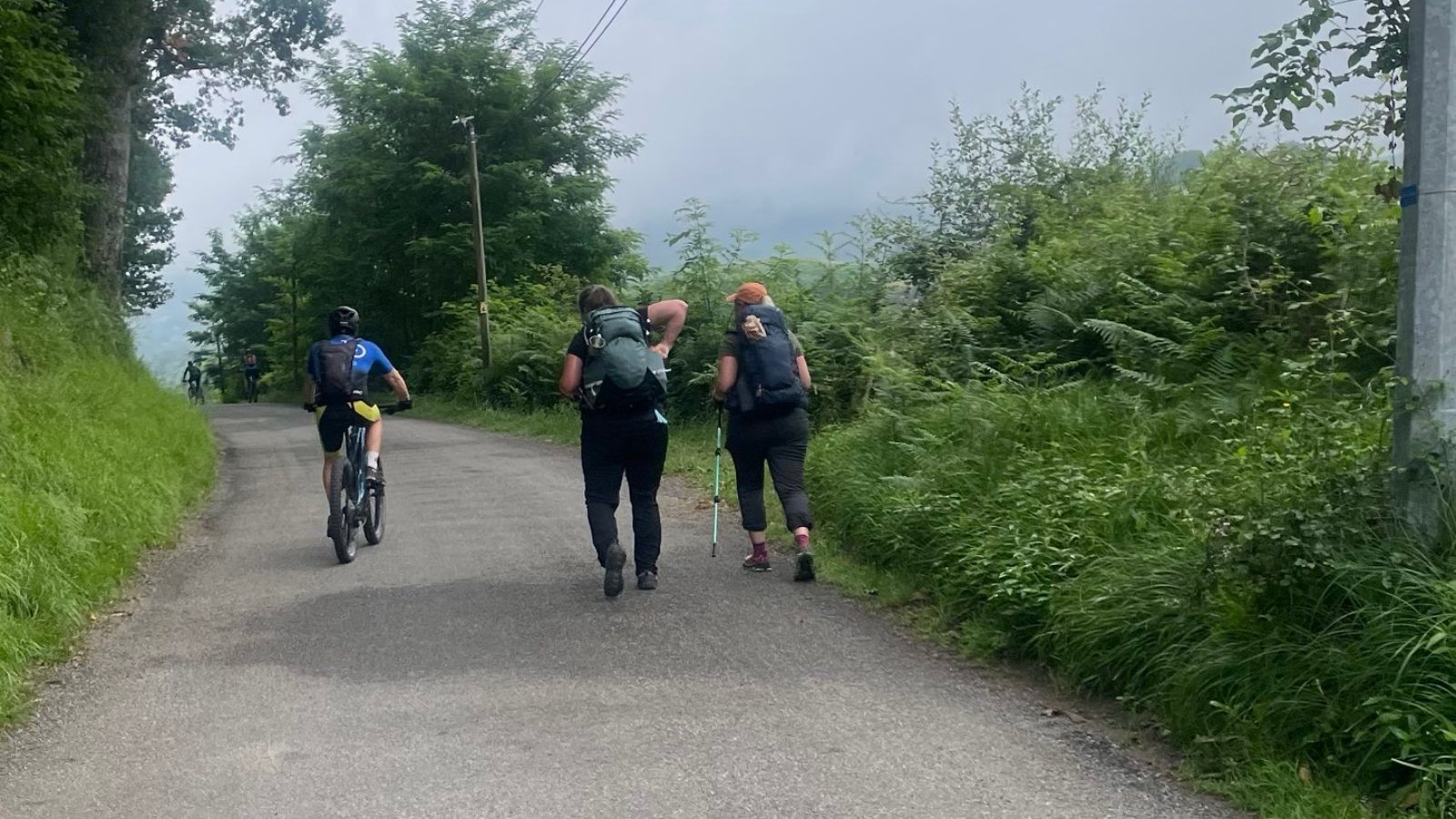
The word turigrino (tourist plus peregrino, pilgrim) doesn’t come from any medieval text. It was born in forums and hostel conversations to describe people who treat the Camino as a holiday, without the spirit of simplicity and hospitality many see as its core. It’s usually aimed at three profiles: people who send their backpack ahead by van, people who sleep in hotels and people on e-bikes.
Our view, after many years in this: what makes someone a pilgrim isn’t how they travel, it’s their attitude.
- There are walkers with 10-kilo backpacks who drop litter by the roadside and treat the hospitalero like a waiter.
- There are bicigrinos on e-bikes who give way, take their time at every stamp, share a table and reach the Obradoiro as moved as anyone.
Besides, the Camino has never been done just one way. In the Middle Ages nobles, merchants and people of every kind made the pilgrimage on horseback, with all sorts of motives. The Pilgrim’s Office itself awards the Compostela for distance covered and stamps collected, not for how much you suffered.
That said, we understand the underlying concern. Some stretches of the Camino are getting very crowded, and it’s natural to worry about it becoming just another product. The answer, we believe, isn’t handing out pilgrim licences but asking everyone for respect: for those who walk, those who ride and the villages that welcome us.
Comparison: walking, cycling or e-biking
| On foot | Regular bike | E-bike | |
|---|---|---|---|
| Typical daily distance | 20-25 km | 50-80 km | 50-80 km |
| Full Camino Francés (approx.) | 30-35 days | 11-14 days | 10-13 days |
| Physical demand | Medium-high and sustained | High on climbs | Moderate and adjustable |
| Minimum distance for the Compostela | 100 km | 200 km | 200 km on a regular bike (the Office doesn’t accept e-bikes) |
| Accommodation | Public and private hostels | Hotels and hostels with bike storage | Same, plus a socket to charge |
| Best for | People with weeks to spare who want a slow pace | People who want the whole Camino in a normal holiday | Mixed groups, over-60s, sensitive knees |
Day counts are a guide only: they depend on terrain, fitness and how much you feel like stopping.
So, how should I do it?
- You have a month and want the classic experience: walk it, no question.
- You have 10 to 15 days and want to do the whole route: ride it. If you enjoy pedalling, a mountain or gravel bike.
- You’re a couple or group with different fitness levels: e-bikes for whoever needs them, so no one gets left behind.
- You’ve already walked it: doing it again by bike is discovering a different Camino. Many returning pilgrims tell us so.
How Bicigrino can help

If you choose to ride, that’s exactly what we do. We rent bikes ready for the Camino and deliver them to your starting point: Porto, Lisbon, Saint-Jean-Pied-de-Port, Roncesvalles, Pamplona, Burgos, León, Ponferrada or Irún, among others. When you reach Santiago, we collect them.
Our fleet:
- Cannondale Trail SL2: a regular mountain bike for those who want to ride the old-fashioned way.
- Cannondale Topstone: a nimble gravel bike, fast on tracks.
- Electric MTB: a front-suspension e-bike, our most versatile option.
- Cannondale Moterra Neo 3 (750 Wh): a full-suspension e-bike for maximum comfort.
- AMFLOW Carbon PL (800 Wh): a light carbon e-bike, our top of the range.
You can also book luggage transport and ride without the weight. To plan your stages, use our free stage planner, which works on your computer and as a mobile app, for the Camino Francés and the Portuguese Camino: it works out distances and climbs and shows you accommodation for each stage.
You’ll find all our prices on our rates page, or you can run a test booking in our booking system to see the exact price for your dates.
Riding in 2027? Book now
2027 is a Holy Year and every route will be extremely busy. May and September are already in high demand, and near Santiago (Sarria, Portomarín, Melide) accommodation fills up fast. All the details are in Camino de Santiago 2027: book early.
Pilgrim or bicigrino? In the end, what matters is reaching the Obradoiro having lived the Camino with respect. How you do it is up to you. If it’s on two wheels, we’re here. Buen Camino.
Frequently asked questions
Do you get the Compostela if you do the Camino by bike?
Yes. You need to cover at least the last 200 km of a Camino route and get your credential stamped at least twice a day.
What if I ride an e-bike?
The rules published by the Pilgrim’s Office refer to bicycles without mentioning electric ones, and legally a pedal-assist bike is a bicycle. But the Pilgrim’s Office has stated it does not issue it to pilgrims on e-bikes, so the safe option is to ride the last 200 km on a regular bike. We explain it in our article on e-bikes and the Compostela.
How many kilometres a day do you cycle on the Camino?
Usually 50 to 80 km a day, depending on terrain and fitness. On an e-bike the effort is lower, but a sensible daily distance is similar.
Is it better to walk the Camino or cycle it?
It depends on how much time you have and what you’re looking for. Walking is slower and more social; by bike you can complete a full route in about two weeks. Both are a pilgrimage.
Can I rent the bike at my starting point and leave it in Santiago?
Yes. At Bicigrino we deliver the bike to your starting point and collect it when you finish.


