
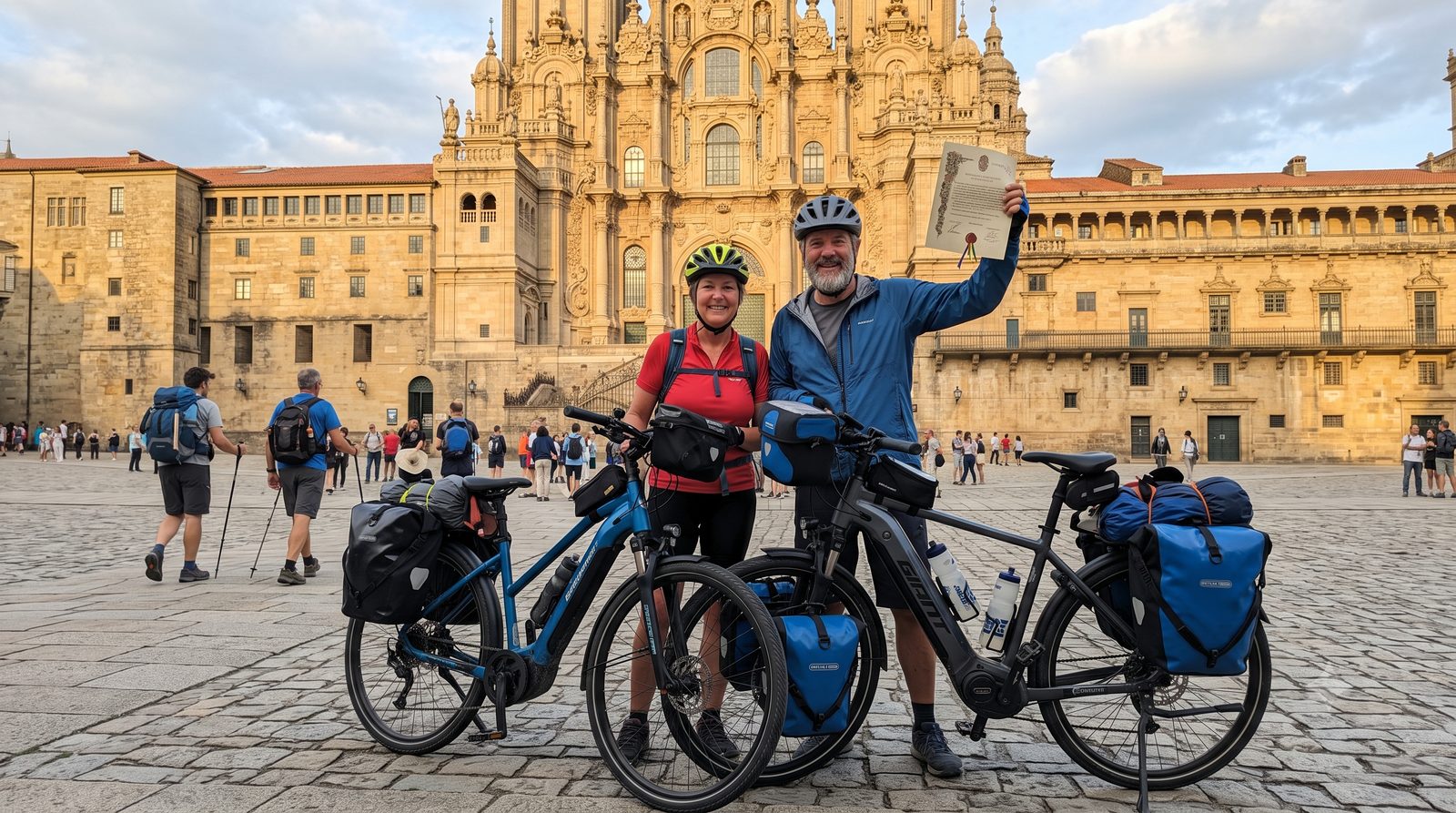
Some questions come back to our workshop every single week, and this one wins by a mile: “if I ride the Camino de Santiago on an e-bike, will I get the Compostela?” We get it in person, by phone and on WhatsApp, in four languages. And most people arrive with the wrong idea, because the written rule doesn’t say what everyone thinks it says. Let’s take it step by step.
The short answer
To qualify by bicycle, the Pilgrim’s Office asks for the last 200 km into Santiago with a stamped credential. That’s everything that’s written down. Electric bikes? Not one word — neither allowed nor banned. Then there’s what happens at the counter, which is a different story, and we’ll get to it below. But be wary of anyone selling you certainty in either direction, because there isn’t any.
What the official rule actually says
It’s published on the Pilgrim’s Reception Office website and takes a minute to read: on foot or horseback, 100 continuous km. By bicycle, 200. By sail, 100 nautical miles plus the last stretch walking. Stamp your credential at the start and end of every stage, and do the route with a religious or spiritual motivation. That’s it. Go and search that text for the word “electric” — it isn’t there.
Is an e-bike a motor vehicle? The law says no
This is where the debate gets decided. Under Spanish traffic law (RD 970/2020, same as the EU rules), a pedal-assist bike is legally just a bike: a motor of 250 W at most, which only helps while you’re pedalling and cuts out at 25 km/h. Stop pedalling and the help stops. There’s no throttle. That’s why so many people argue that riding the Camino de Santiago on an e-bike meets the 200 km rule exactly as written, no stretching required.
What actually happens when you arrive in Santiago
We’ve been hearing “no Compostela on an e-bike” for years. Where does it come from? Mostly from forums and websites run by walking pilgrims. Nothing of the sort has ever been published: it’s a counter criterion passed along by word of mouth, not a rule. At Rúa Carretas nobody comes down to check what bike you rode; what they look at is your credential and your stamps. Part of that discourse is plain purism from people who feel the Camino only counts on foot with a backpack — fair enough, honestly — but the Camino has been adapting to every era for twelve centuries. One more thing: the Cathedral Chapter keeps the power to grant the Compostela in “special circumstances”, and there has always been more leeway for people who need the assistance because of age or health. Our standing advice: do your 200 km, stamp twice a day, and collect your Compostela without a second thought. You pedalled every one of those kilometres yourself.
Our view: effort is not measured in watts
We know a thing or two about this — renting e-bikes for the Camino is what we do. And what we see every season isn’t people dodging the effort; it’s people sharing it out. On an e-bike you still pedal every kilometre, you still get soaked when it rains, and O Cebreiro still gets climbed with your own legs — the motor just takes the part that was too much. What really changes is who gets to try: couples where one rides strong and the other doesn’t, pilgrims in their 60s and 70s, someone coming back from a knee injury. These days more than one in ten pilgrims rolling into the Obradoiro arrives on a bike, and a growing share of them ride with assistance. The Camino is about reaching Santiago, not about suffering more than the person next to you.
Tips for riding the Camino de Santiago on an e-bike
- If you want a shot at the Compostela, plan at least 200 km. From Ponferrada on the French Way or Porto on the Portuguese you have plenty of margin.
- Stamp your credential twice a day, with the date: when you set off and when you arrive. It’s the only proof that counts.
- The battery: work out your range per stage and charge every night. Our guide on where to sleep on the Camino by bike lists places used to cyclists and their chargers.
- And book early — the Holy Year 2027 is just around the corner and places will go fast.
Frequently asked questions
How many kilometres do I need on an e-bike for the Compostela?
The same as on any bicycle: the last 200 km into Santiago, with your credential stamped at the start and end of every stage.
Does the official rule ban electric bikes?
No. The official text of the Pilgrim’s Office only mentions “pilgrimage by bicycle” and 200 km. The e-bike exclusion is a counter criterion passed around by word of mouth, not a written rule, and nobody checks what bike you rode when you collect the document.
Can I ride the Camino on an e-bike with reduced mobility?
Yes — that’s exactly where pedal assistance makes the most sense. The Cathedral Chapter keeps the power to grant the Compostela in special circumstances: mention your case at the Pilgrim’s Office when you arrive.
Where do I charge the battery along the Camino?
At your accommodation each night. Practically every hotel and hostel on the Camino will let you plug it in overnight, and a full charge costs cents.
Want to try? We bring the e-bike to the start of your Camino
Ours come with panniers and we deliver them wherever your route begins. Plan your stages for free with our Camino bike route planner and book your e-bike here. Oh, and if 2027 is already on your mind: book in 2026 and get 10% off with the code BICIGRINO2027.


