

Every so often we get the same question, usually from riders with a mountain bike background: “Why don’t you rent full-suspension bikes without a motor?” It’s a fair question. Full suspension is comfortable, it soaks up bumps and it gives you plenty of confidence on a technical descent. If you spend your weekends on singletrack, it’s natural to assume it will also be the best choice for the Camino.
It isn’t. And this has nothing to do with our catalogue or our budget: it’s a technical decision we’ve made after many years watching thousands of cyclists ride into Santiago. Here’s why, explained properly, because understanding it will help you choose the right bike whether you rent from us or not.
The Camino isn’t an enduro trail: it’s a loaded tour
Start with what the Camino de Santiago by bike actually asks of you. You ride 50 to 90 kilometres a day for one or two weeks, mixing tarmac, compacted dirt tracks, gravel and the odd stretch of loose stone. There are long, steady climbs, like O Cebreiro or the Cruz de Ferro, and far fewer technical descents.
Above all, you travel with luggage. Most people carry 6 to 12 kilos in rear panniers: clothes, rain jacket, tools, a spare tube, some food and water.
That changes everything. A bike designed to descend a trail fast with a light rider and no load is not necessarily the best tool for pedalling 700 kilometres with 10 kilos hanging off the back.
Pedal bob: when the bike “rows” with you
This is the heart of the problem. On a full-suspension bike, the rear shock can’t fully tell the difference between a bump in the track and the push of your legs. Every time you press down on the pedal, part of that force compresses the rear suspension; as the crank passes the dead spot, the shock extends again. The result is a rhythmic up-and-down, back-and-forth motion known as pedal bob. We call it the rowing-boat effect, because that’s exactly what it feels like: the bike rocks with every pedal stroke.
This isn’t just riders’ folklore. The industry acknowledges it in its own patents: rear suspension movement caused by the rider rather than the terrain means lost energy and lost performance. The physics is simple. When pedalling compresses the suspension, part of your power goes into compressing the shock, and that energy ends up as heat in the damper oil. It leaves your legs and never reaches the wheel.
Manufacturers have spent decades trying to reduce it with linkage designs, anti-squat geometry and lockouts. The sheer number of patents aimed at the problem is the best proof that it’s real.
“But studies say the loss is small”
That’s true, and we want to be upfront about it: a good argument doesn’t hide the data that doesn’t suit it.
The reference study, carried out at the Catholic University of Louvain with competitive cyclists, compared rigid, front-suspension and full-suspension bikes on a lab ergometer. It found no significant difference in oxygen consumption: at most, 3% more than the rigid bike.
But look at the test conditions: expert riders, seated, with a very smooth pedal stroke, on a perfectly flat ergometer and, crucially, with no luggage. The authors themselves note that the loss could become significant at higher power outputs, when riding out of the saddle or because of the terrain.
In other words, the study measures the best possible scenario for full suspension. The Camino is the exact opposite:
- Standing on the climbs. On ramps like O Cebreiro almost everyone gets out of the saddle. That’s exactly when bob kicks in, because your body weight drops onto each pedal.
- Riders who aren’t racers. A racer has a smooth, steady stroke. A touring cyclist tends to push in surges, and every surge is an impulse the shock absorbs.
- More weight on the shock. Rider plus panniers means more sag and more travel used on every stroke.
- Long hours in the saddle. 3% in a short lab test is little. A small percentage lost over six or seven hours a day, for a whole week, shows up in your legs and in your head.
So our argument isn’t that full suspension steals “half your power”. It’s that, in real Camino conditions, the loss grows exactly when it hurts most, on a bike that also brings the problems we explain below.
Direct power transfer: the real reason
If we had to sum up this article in one idea, it would be this: on a bike with a rigid rear end, all the force you put through the pedal reaches the wheel. Nothing in between compresses, stretches or moves. The chain pulls and the wheel turns.
That direct transfer is what gives you a smooth, round pedal stroke, and on the Camino that matters far more than absorbing the occasional bump. Think of the Castilian meseta: dozens of kilometres of flat dirt tracks or long, gentle climbs between Burgos and León, where what makes the difference isn’t technique or suspension but cadence. Holding a steady rhythm for hours without the bike swallowing part of every stroke. On that terrain a rigid bike moves forward; a full-suspension bike without a motor rocks.
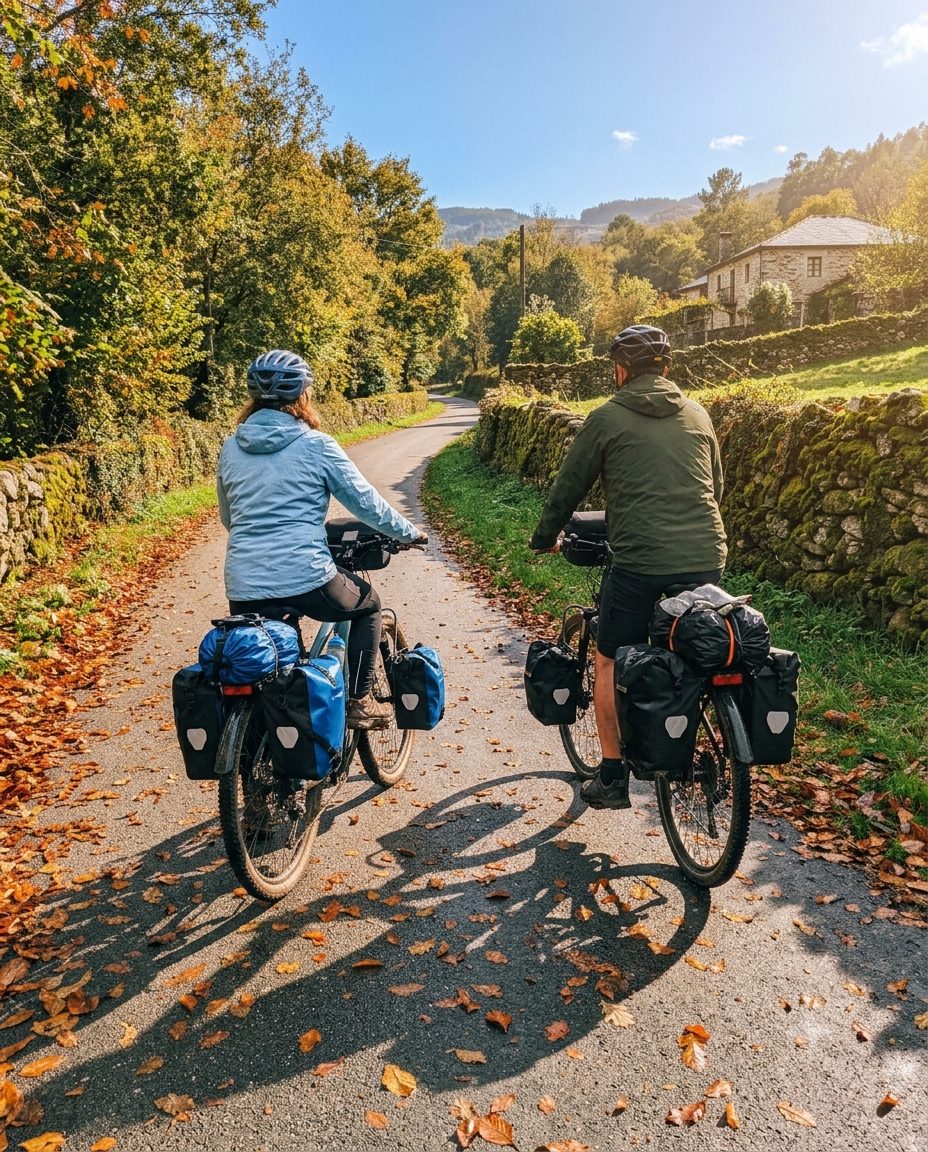
It’s no coincidence that gravel bikes have become one of the big stories of the Camino de Santiago in recent years. We see it every season: more and more cyclists arrive in Santiago on gravel bikes. They’re after exactly that, direct power transfer from rider to rear wheel, with tyres wide enough for dirt and gravel and a riding position built for long days.
What about panniers?
Some people assume you simply can’t carry panniers on a full-suspension bike. That’s not the case: there are rear racks designed specifically for full-suspension frames, and we use them every day on our e-bikes. Carrying luggage isn’t the problem.
The problem is what that luggage adds to the equation on a bike without a motor. With six, eight or ten kilos on the back, the rear suspension works under more weight, sags further with every stroke and the rocking gets worse. The load doesn’t solve the rowing-boat effect: it amplifies it. On a rigid frame, those same kilos simply travel with you.
A shock working outside what it was designed for
There’s a technical point that almost nobody explains and that, for us, is decisive. The rear shock on a full-suspension mountain bike is designed and tuned for a specific weight range: that of a normal rider for that frame size. The spring curve, the sag, the rebound speed and the available travel are all calculated for that weight and for a very particular job: absorbing hits from the terrain with a light bike and a rider on top.
Hang panniers on it and you push the shock out of that working range. The consequences go beyond less efficient pedalling:
- It sags too much. With the extra weight the shock starts already compressed, has less usable travel left and bottoms out more easily over bumps.
- Compensating means running much higher pressure. Then it stops following the ground: it turns harsh over small bumps, the most common kind on the Camino, while still bobbing when you pedal.
- Rebound goes out of balance. A shock set up for a 75 kg rider doesn’t control the return stroke the same way when it’s carrying 85 or 90. The rear end bounces and “floats”, and the load sways with it.
- More wear and a higher risk of failure. Working constantly outside its range punishes seals, bushings and pivot bearings. Exactly the kind of breakdown you don’t want halfway through a stage, far from a workshop.
A full-suspension mountain bike is an excellent tool for what it was designed for. Loading it up like a touring bike is asking it to do a job it wasn’t built for.
More weight, more maintenance, more things to go wrong
A full-suspension bike without a motor weighs more than an equivalent rigid one: shock, linkages, bearings and extra hardware. You have to haul that weight, stroke by stroke, up every climb on the Camino.
It also has more parts that can fail hundreds of kilometres from home: a shock losing pressure, pivot bearings suffering in Galician mud and rain. On a trip where all you want is to ride and enjoy it, every part less is one less thing to worry about.
“What if I lock out the shock?”
Many full-suspension bikes let you lock out the rear shock, and that works well on tarmac and climbs. But think about it: if you’re going to spend most of the Camino with the rear locked, what you’re riding is a heavier, more expensive rigid bike with more parts to maintain. And if you forget to lock it, which happens all the time when you’re tired, you’re back to the rowing-boat effect.
What we do recommend without a motor: gravel or a hardtail
For loaded touring, and the Camino in particular, we recommend two types of non-electric bike:
- Gravel. Fast and efficient on tarmac and tracks, comfortable thanks to wide tyres, with rack mounts and a position designed for long hours. Ideal if you want to cover ground with ease.
- Hardtail mountain bike (front suspension only). The fork absorbs the hits you feel most, the ones that reach your hands and arms, while the rigid rear end sends every stroke straight to the wheel and carries a pannier rack without fuss. The most versatile option if you want more control on rocky sections.
Comfort at the back is better achieved in other ways for this kind of trip: a good saddle, slightly wider tyres at the right pressure and quality cycling shorts.
Why full suspension does make sense on an e-bike
Here’s the part many people don’t expect: on an e-bike, we do recommend full suspension. It isn’t a contradiction. It’s the same logic applied to a different machine.
The case against non-electric full suspension is about efficiency: every watt lost in the shock comes out of your legs, and your legs are your only engine. On an e-bike that changes completely.
- The motor makes up the loss. Whatever bob there is gets covered by the assistance. The efficiency edge of a rigid bike matters much less, and you keep all the benefits of full suspension.
- Smoother pedalling, fewer surges. With assistance you don’t need to push hard on every stroke: force is spread more evenly through the pedal cycle and the motor fills in the dead spot. Fewer surges means less shock movement. Torque-sensing motors, like Bosch’s, match the help to the force you actually apply and smooth the delivery even further.
- More weight, more need for suspension. An e-bike is considerably heavier and rides faster over rough sections. That’s where rear suspension adds real traction, control and comfort, and reduces fatigue on long days.
- E-bike-specific shocks. Precisely because an e-bike is heavier and sturdier, it uses shocks made specifically for e-bikes, different from those on a regular mountain bike, built and tuned for much higher total weight and for the extra forces the motor generates. That margin is what lets you carry panniers without pushing the suspension out of its working range.
- Designed for this from the start. Modern e-MTBs keep the motor and battery low and central in the frame, so the weight distribution stays stable even though the bike is heavy.
That’s why our full-suspension e-bike for the Camino is the Cannondale Moterra Neo with a Bosch motor. And yes, it takes panniers: we fit a rear rack designed for full-suspension frames, so you travel with your luggage just as you would on a rigid bike.
Put another way: on a bike without a motor, full suspension charges your legs for the comfort it gives you. On an e-bike, the motor pays that bill and you keep the comfort.
Our fleet: chosen for the Camino
Nothing in our rental fleet is there by chance. At Bicigrino we’ve picked what we consider the best range of bikes for a route like the Camino de Santiago, and each one suits a different kind of rider:
- Gravel (non-electric), for riders who want agility and direct power transfer on tarmac, tracks and the meseta.
- Hardtail mountain bike (non-electric), for those who want more control on rocky sections without giving up efficient pedalling.
- Hardtail e-bike, for riders who want help on the climbs with a simple bike that’s easy to load.
- Full-suspension e-bike (Cannondale Moterra Neo), for maximum comfort and traction, with the motor making up for what the rear suspension takes away.
The only one missing is, precisely, the one we don’t recommend: the non-electric full-suspension mountain bike. We don’t have it because we don’t think it’s the right tool for this trip. You can see every model on our Camino de Santiago bike rental page.
Our recommendation at a glance
| Bike type | Do we recommend it for the Camino with panniers? | Main reason |
|---|---|---|
| Gravel (non-electric) | Yes | Efficient, light, direct power transfer |
| Hardtail MTB (non-electric) | Yes | Versatile, direct pedalling, reliable load carrying |
| Full-suspension MTB (non-electric) | No | Pedal bob, shock not designed for the load, extra weight |
| Hardtail e-bike | Yes | Assistance and easy load carrying |
| Full-suspension e-bike | Yes | The motor offsets bob and adds comfort |
FAQ: full-suspension bikes on the Camino de Santiago
Is it a bad idea to ride the Camino de Santiago on a non-electric full-suspension bike?
It isn’t impossible, and some people do it. But for most touring cyclists it isn’t the most efficient choice: you lose energy to suspension bob, especially when climbing out of the saddle and carrying panniers, and on long flat stretches like the meseta the pedal stroke is far less smooth than on a rigid bike.
Can panniers damage the rear shock of a mountain bike?
They can put it under more strain than it’s meant for. The shock on a non-electric full-suspension bike is designed for the weight of a normal rider for that frame size. With panniers it works outside that range: it sags more, bottoms out easily, rebound goes out of balance and seals and bearings wear faster.
What is pedal bob?
It’s the rocking motion produced when the rear suspension compresses and extends in time with your pedal strokes. Part of the rider’s energy goes into moving the shock instead of driving the bike forward.
Does locking out the rear suspension solve the problem?
Partly. It stops the bob, but leaves you on a bike that’s heavier than a rigid one, with more parts to maintain, and it relies on you remembering to lock it on every section.
Why does Bicigrino rent full-suspension e-bikes?
Because the motor makes up for the efficiency loss and smooths out your pedalling, so you get the comfort and traction of full suspension without paying for it in effort. E-bikes also use shocks designed for more weight, and our Cannondale Moterra Neo comes with a rear rack made for full-suspension frames, so it carries panniers without any problem.
Which non-electric bike is better for the Camino: gravel or mountain bike?
Gravel if you want agility and will ride mostly on tarmac and tracks. A hardtail if you prefer more control and comfort on loose, rocky sections. Both carry panniers without any problem.
Pick the right bike and you’ll enjoy the Camino twice as much
If you’re not sure which model suits your route, your fitness and your luggage, get in touch and we’ll advise you with no obligation. If you’re still choosing your route, our guide to the best Camino de Santiago route to cycle can help. And to plan your stages in detail, our route planner for the French Way and the Portuguese Way organises them for you on your computer or in the mobile app.


