🌊 Muxía: where the Camino merges with the ocean
After arriving in Santiago de Compostela, many pilgrims feel that their journey is not yet over. The urge to continue westward, to the sea, is almost ancestral. That is why there is a natural extension of the Camino: the stage that leads from
This final stretch is more than a physical journey: it is a
🏞 The Costa da Morte: where beauty and tragedy embrace
The Costa da Morte gets its name from the countless shipwrecks that have taken place in its waters. Over the centuries, this rugged coastline has witnessed countless tragedies, becoming a symbol of respect and devotion for sailors and pilgrims.
Among these episodes, the Prestige disaster stands out. In November 2002, the tanker sank off these coasts pouring thousands of tons of fuel oil, polluting beaches, cliffs and ecosystems. It was a deep wound for Galicia, but also an example of solidarity: thousands of volunteers came from all over Spain under a slogan that still resonates in the collective memory – “Nunca Máis”.
Today, the waters of Muxía have recovered their purity and the landscape has once again become a song of hope in the face of the immensity of the ocean.
🪨 Magic stones and ancestral rites
Long before the arrival of Christianity, the promontory where the sanctuary stands was a sacred Celtic site. Here, the ancient Galicians worshipped the sun, the sea and the forces of nature. The boundary between the human and the divine was so thin that rituals were performed directly on the stones.
These are the main sacred stones of Muxía and its mysteries:
A Pedra de Abalar: the most famous. It was said that it only moved with the passage of the righteous. It was used in divine judgments and to ward off diseases or bad energies.
A Pedra dos Cadrís: shaped like a natural arch, pilgrims pass under it nine times to cure back or kidney pains.
A Pedra do Timón (also called Pedra de Os Cadrís): symbol of the rudder of the stone boat in which, according to legend, the Virgin Mary arrived to encourage the apostle Santiago.
The Christian tradition reinterpreted these cults, saying that the stones were the remains of the boat of the Virgin. But under this religious varnish still beats the Celtic spirit, the echo of a magical Galicia, where the stone and the sea continue to speak the same language.
⛪ El Santuario da Virxe da Barca
The current sanctuary dates back to the 17th century, although its origin goes back much earlier. It has been rebuilt several times after fires and storms, the last one in 2013, when lightning caused a devastating fire.
Its silhouette, made of granite and sea, seems to resist the passage of time against the waves that hit the rocks. From its esplanade you can contemplate the infinite Atlantic, and on clear days, the horizon seems to merge with the sky.
For many pilgrims, Muxía is a place where the Camino becomes a rite, where every stone is a prayer and every wave an answer.
🎬 “The Way”: the symbolic end of a universal story
The magnetism of Muxía transcended even to the cinema. The movie
In the final scene, the protagonist arrives at the sanctuary and, looking at the ocean, lets fly the ashes of his son. It is a perfect closure: a tribute to the inner search that the Camino represents, and to that feeling that the end is never an end, but a transformation.
🚴♂️ Pedaling to the end of the world
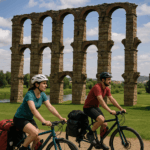
The stage from Olveiroa to Muxía is one of the most beautiful of the Camino. It crosses valleys, stone villages and paths that gradually open to the sea. The smell of salt announces the arrival at the Atlantic, and with it, the symbolic end of the journey.
For the bicigrino, arriving at the sanctuary with the sound of the waves and the sea wind is an experience of plenitude. A moment of pause, reflection… and farewell.
✨ The true end of the Camino
Muxía is not only the point where the Camino ends; it is the place where another way of understanding it begins.
Here there are no crowds or queues in front of the cathedral. Only the murmur of the sea, the ancient granite and the echo of the footsteps that come from all the roads of Europe.
Upon arrival, many leave a stone on the rocks or a shell on the beach, continuing a rite as old as humanity: to leave a part of oneself in order to continue walking lighter.
Because Muxía is not the end of the Camino… it is the beginning of another illusion.